Japan's breach advice is aimed at the wrong people
This week's Mr.サンデー gave viewers three sensible tips after the Rakuten Securities leak, then asked whether security spending would push prices up. The companies that skipped the bill went unexamined.
Published · mkultraman.com
Domain Exposure Report. One domain. Public records only. The three fixes to make first.
Get the full report ¥5,000 + tax

Part of: Japan Cybersecurity Tracker
In this article: 4 sections
This week’s Mr.サンデー gave viewers three sensible tips after the Rakuten Securities leak, then asked whether security spending would push prices up. The companies that skipped the bill went unexamined.
I was at home in Tokyo on Sunday night, 22 November, watching Fuji TV’s Mr.サンデー. One of the segments, listed in the program guide as「楽天流出情報の行方」, walked through the Rakuten Securities leak disclosed on 17 November. The guest was 棚瀬誠, a security consultant, introduced on screen as a former National Police Agency cyber investigations chief (サイバー捜査課長) and a former head of Interpol’s economic-crime unit (経済犯罪班長).
His tips were good. Then the conversation stopped at the people whose data had already leaked.
Three good tips, aimed at the customer
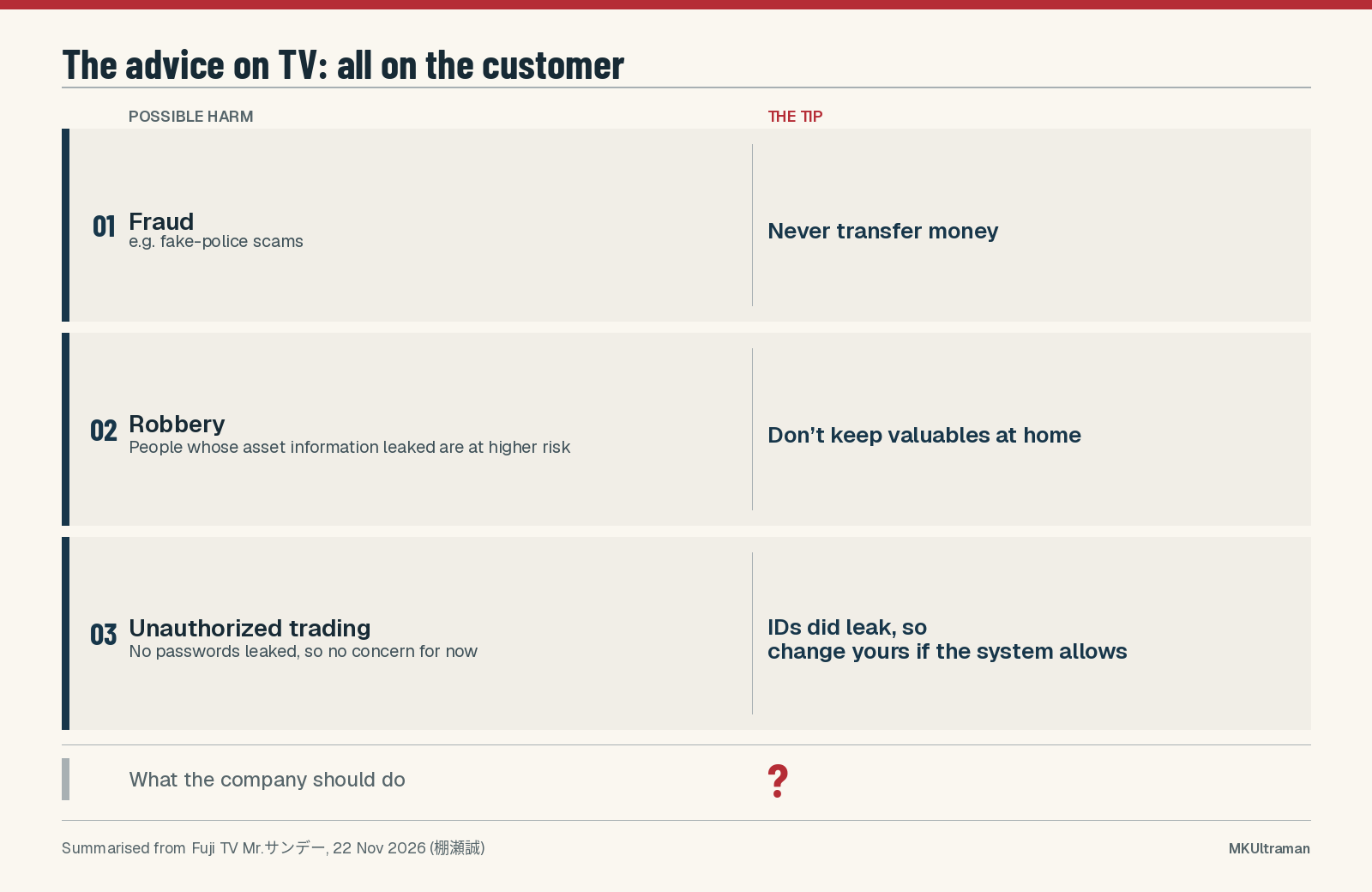
The segment put up a panel,「情報漏えい 考えられる3つの被害」, with three risks and three countermeasures:
- Fraud, including fake-police scams (偽警察官詐欺). The advice: don’t wire money, no matter what.
- Robbery. People whose asset information has leaked are at higher risk. The advice: don’t keep cash or valuables at home.
- Unauthorized trading. Passwords were not leaked, so there’s no immediate worry, the show said. The advice: your login ID has leaked, so if the system lets you change it, you should.
That’s sound advice for anyone living here right now. I would tell family members the same things. Don’t wire money to someone claiming to be a police officer. Don’t assume an email or a phone call that recites your own details is genuine. Change what you can change.
But look at where the work lands. The login ID leaked because Rakuten Securities copied real customer data into a test environment, a practice copy of a system that should only ever hold dummy data. Up to about 4.47 million accounts had names, addresses, employers, withdrawal bank accounts and self-reported income and assets in it. Up to another 11.25 million lost account codes and login IDs. As I wrote in Rakuten Securities approved the conditions for its own breach, the company told ITmedia the data was copied there through a formal internal procedure. Somebody signed off on it.
ANN’s 報道ステーション asked why real customer data was sitting in a test environment, and reported the Financial Services Agency’s order that Rakuten Securities explain what happened. Video: 住所・資産など…なぜ“テスト環境”から顧客情報漏えい 金融庁が楽天証券に報告徴求【報道ステーション】(2026年11月20日) from ANNnewsCH.
And the customer is told to change the ID, if the system lets them.
The banner on screen was「楽天証券 情報漏えい「詐欺・強盗」の懸念 プロに聞く“今すべき対策”」. The professional is asked what you should do now. The company’s shortcomings barely enter the frame. It’s a tidy piece of victimhood television: three things you can do, and almost nothing about what the company failed to do.
Security isn’t a new cost. It’s a bill most firms skipped
Then came the economic hook:「セキュリティー費用増で物価高に拍車?」 Will higher security costs fuel inflation?
The same segment showed a chart from IPA, Japan’s government IT security agency, on what small and mid-sized firms spent on information-security measures. The numbers on screen were from IPA’s FY2024 survey. 2,623 of 4,191 (62.6%) SMEs had made no security investment across three survey periods. Another 20.4% had spent under ¥1 million.
The bands above that were thin: 4.7% spent ¥1 million to ¥5 million, 2.1% spent ¥5 million to ¥10 million, 1.1% spent ¥10 million to ¥20 million, 0.7% spent ¥20 million to ¥50 million, 0.3% spent ¥50 million to ¥100 million, 0.1% spent ¥100 million to ¥400 million, and 0.1% spent ¥400 million or more. 7.9% didn’t know.
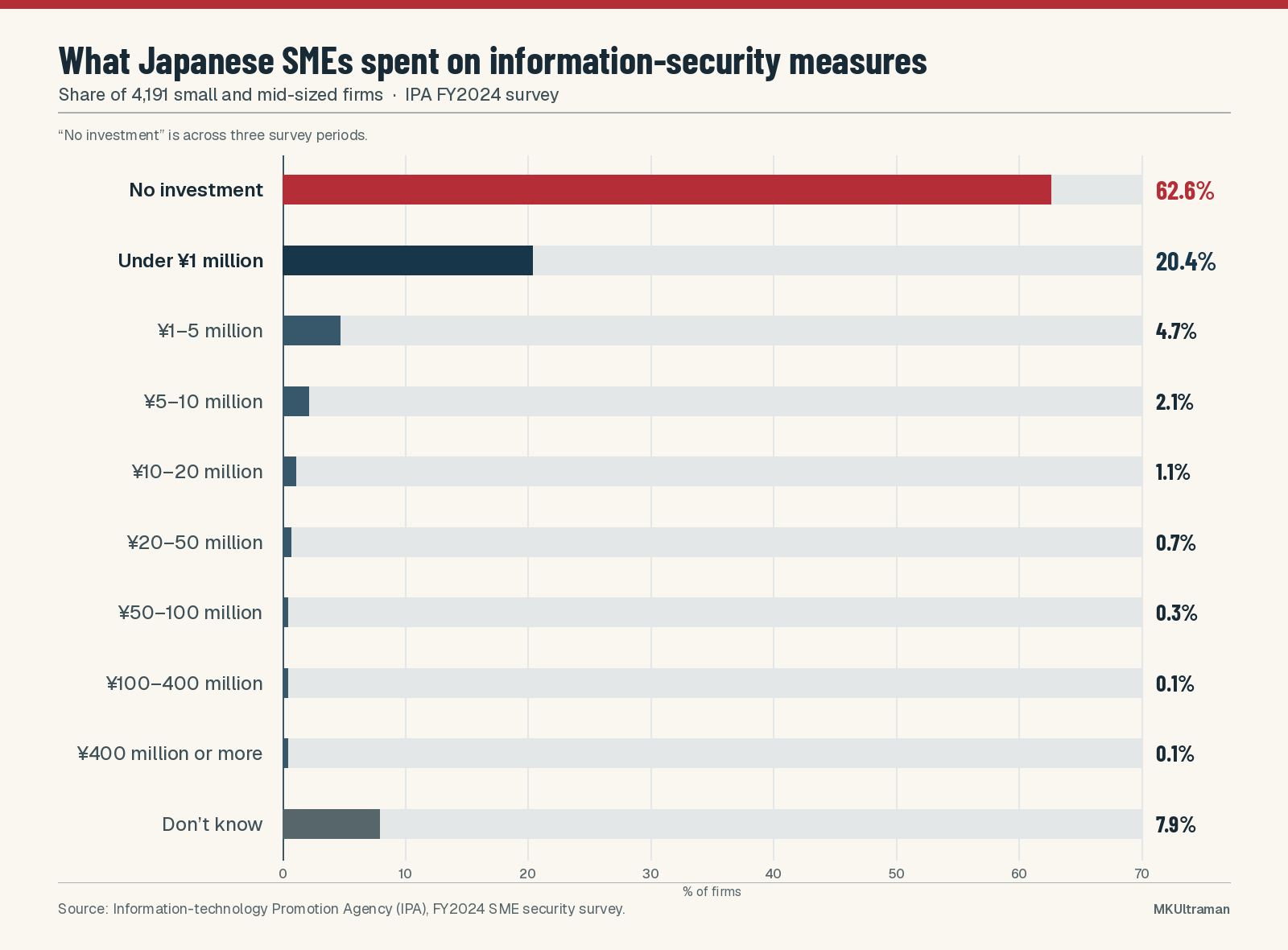
That’s not a picture of companies straining under a new cost that will show up in prices. It’s a picture of companies that mostly weren’t paying the bill.
The reasons are in the same report. Of the firms that spent nothing, 1,162 of 2,623 (44.3%) said they didn’t see a need. 634 of 2,623 (24.2%) couldn’t see a return. 570 of 2,623 (21.7%) said the cost was too high. And 2,920 of 4,191 (69.7%) had no organized security setup at all: it was left to each person to handle.
IPA, the government agency behind those figures, made this explainer for small firms that assume they have nothing worth stealing. Video: あなたの会社のセキュリティドクター ~中小企業向け情報セキュリティ対策の基本~ from IPA Channel.
Listed companies don’t look much better on the management side. In JUAS’s 2026 IT trends survey (JUAS is an association of corporate IT users), only 257 of 957 (26.9%) listed or equivalent firms had a CISO, the executive in charge of security. 558 of 957 (58.3%) hadn’t even considered appointing one. On spending, 330 of 576 (57.3%) firms that answered put 10% or more of their IT budget into security, so the firms that do spend are not all doing it on the cheap. The gap is between those firms and the ones that still see no need.
Japan’s security market as a whole is not small. Yano Research put it at ¥1.9471 trillion in FY2025. According to IDC figures in the MIC 2026 White Paper (MIC is the communications ministry), foreign vendors accounted for 60.2% of security product sales in Japan in 2025, and domestic vendors 8.0%. The money is there. A lot of it is just not being spent by the companies that hold other people’s data.
Accountability is starting to show up in court, not on Sunday-night television
I’m on the ground in Tokyo dealing with this every week, and the pattern is the same one I laid out in Japan’s breach wave is the operating model of Japan Inc., laid bare. As of 20 November, my Japan Cybersecurity Tracker holds 1,925 incidents, and 1,294 of 1,925 (67.2%) came through a vendor rather than the company whose name is on the notice. Rakuten Securities is the other kind of case: no outside vendor, a decision made in-house, and a test environment full of real customers.
For years the script after a leak has been an apology letter and a call center. What’s changing is the lawsuits. Tokyo lawyer Yuki Makino of Makino Law Office is organizing group suits over Times Car and Rakuten Securities. The Times Car case site passed 100,000 sign-ups by 26 October. The Rakuten Securities site opened on 18 November and had about 6,000 sign-ups on the first day, over 15,000 by the morning of 20 November, and over 20,000 by 2 p.m. the same day.
Neither case has been filed yet. Registration on the Rakuten site is a statement of intent, not a lawsuit. But tens of thousands of people asking a court to look at a company’s failures is a different conversation from “don’t keep cash at home.”
ANN covered Yuki Makino’s 26 October press conference on the Times Car case, where he called Park24’s ¥3,000 payment too low and said more than 100,000 people had signed up. Video: 「タイムズカー」情報漏洩 集団訴訟へ 見舞金3000円「低すぎる」(2026年10月26日) from ANNnewsCH.
Makino’s framing is the right one. A list of who holds how much money, and where they live and work, isn’t only a privacy problem. It’s a public safety problem. The show was right to warn people about fraud and robbery. It just treated those risks as the viewer’s problem to manage, after the fact.
TBS reported that more than 15,000 people had already signed up for a group lawsuit, and that some customers were fitting security cameras at home. Video: 「住所と資産が知られたら狙われる」監視カメラ設置する利用者も…楽天証券の個人情報流出問題 集団訴訟準備に1.5万人超登録|TBS NEWS DIG from TBS NEWS DIG Powered by JNN.
The fix doesn’t have to push prices up
None of this is a reason to stop giving people practical advice. Tanase’s tips are things I would tell my own family. The critique is of where the conversation stops.
The fix on the company side doesn’t have to be a spending spree that feeds inflation. It means reviewing every vendor that touches customer data, keeping the ones you actually need, and replacing the rest with providers that have a stronger track record, or bringing the work in-house. It means understanding your own systems well enough to know where the data sits, including the test environments. Doing less, and running it well, is cheaper than a year of apology letters, call centers and, now, group lawsuits.
It’s fixable. The companies that get through this in good shape will be the ones that own the whole system, not the ones that ask their customers to change an ID after it has already leaked.
If you need any help, don’t hesitate to get in touch.