Japan's smartphone location data is for sale. Nikkei just proved it.
Nikkei Asia obtained brokered smartphone location data covering more than 40 million devices in Japan and traced phones through the prime minister's office and over 300 Self-Defense Force facilities. What the investigation found, why Japanese law only partly covers it, and what your business should do about it.
Published · 3 sources · mkultraman.com
Decision Session. 45 minutes, live, on your systems and the decision in front of you.
Book a Decision Session ¥28,000 + tax
Part of: Japan Cybersecurity Tracker
In this article: 7 sections
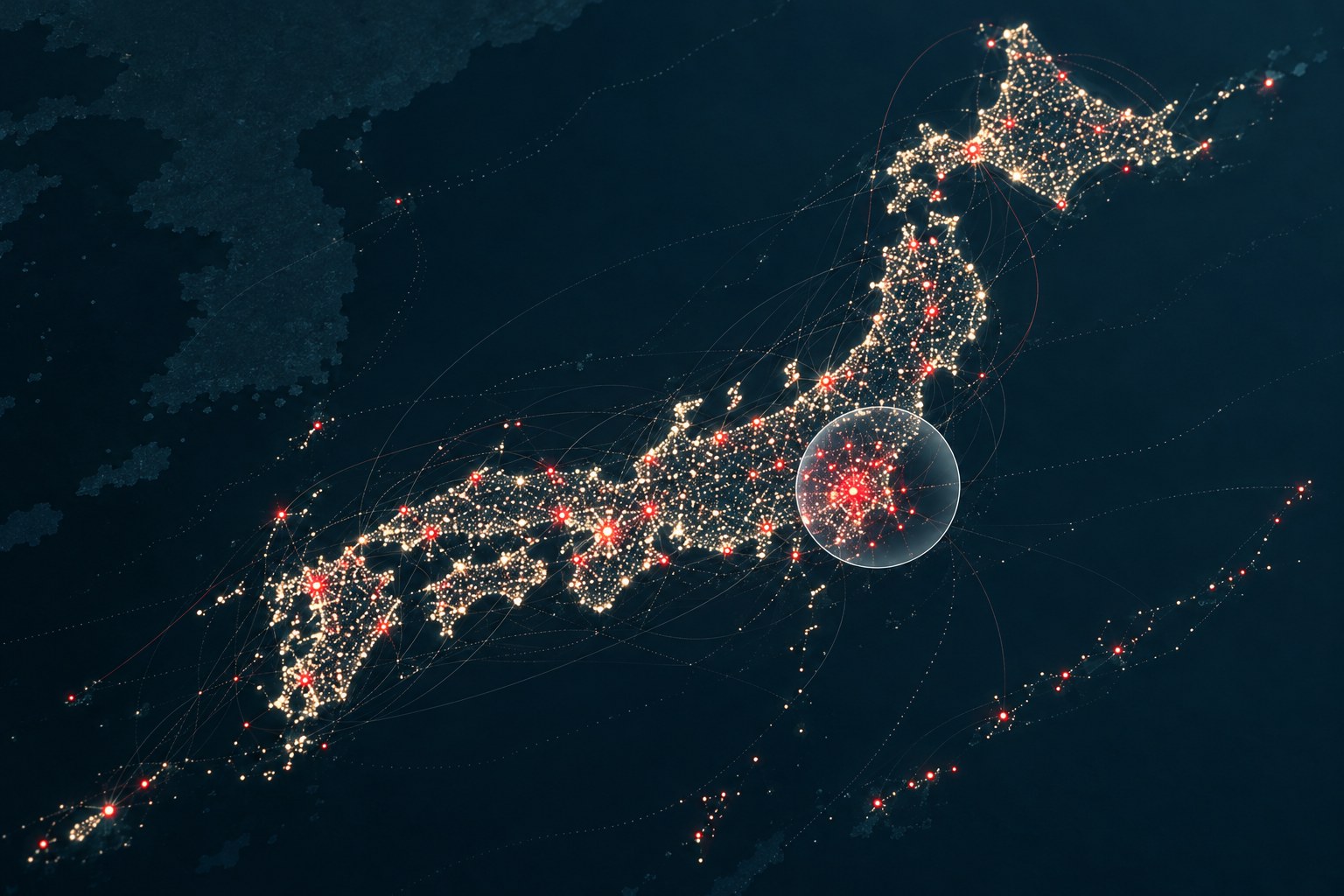
The location history of smartphones in Japan is being sold, and it is legal to buy and detailed enough to follow a Self-Defense Force officer home. That is not a worst-case scenario from a policy paper. It is what Nikkei Asia’s visual investigation team demonstrated on November 16, in an investigation called The Tracked Nation, and it is some of the most valuable public-interest technology journalism published in Japan in years.
I want to say that part plainly before getting into the findings. Nikkei’s team did the work that regulators, carriers, and app platforms have not: they contacted 18 data brokers, obtained real datasets, verified what the data could show, and published the receipts. This is what informing the public about digital developments and risk actually looks like. Japan needs more of it, and the rest of us should be louder about why it matters.
What follows is a summary of Nikkei’s reporting, then what it means if you run a business here. The findings are theirs. The analysis at the end is mine.
What did Nikkei’s Tracked Nation investigation find?
Nikkei contacted 18 overseas data brokers that buy and sell location data. One supplied a free sample dataset without a contract: an anonymized ID per smartphone, each linked to latitude and longitude coordinates and timestamps. Covering all of Japan for about a month, the sample held roughly 40 billion records tied to more than 40 million device IDs.
Inside that sample, Nikkei found:
- Devices going in and out of government buildings, including the prime minister’s office, the National Diet Building, and the building housing the Cabinet Secretariat.
- Location records at 304 facilities belonging to the Defense Ministry and the Ground, Maritime, and Air Self-Defense Forces, with more than 10,000 device IDs recorded on at least 12 days each.
- The movements of an apparent Maritime SDF officer, recorded continuously enough to infer a home address and a daily routine around Yokosuka.
- An apparent Ground SDF officer at Camp Asaka whose data held about 170,000 location records in a single month, an average of roughly four per minute.
Separately, Nikkei purchased datasets from other brokers and found location records around the State Guest House in Tokyo in the 24 hours before Prime Minister Sanae Takaichi’s meetings there with US President Donald Trump in October 2025 and French President Emmanuel Macron in April 2026, and similar patterns at the prime minister’s office around her meetings with the Canadian and Italian prime ministers. The grounds are restricted to authorized personnel. The phones inside them were reporting out anyway.
This is not only a Japanese problem, and other governments know it. In April, US Central Command told Congress it had received multiple threat reports about adversaries exploiting commercial location data to target or surveil American personnel. In 2025, European outlets jointly analyzed some 13 billion brokered location records and found more than 500 devices at NATO headquarters in Brussels, along with the home addresses of three senior officials who had worked for the EU.
How does a phone’s location end up for sale?
Mostly through ordinary apps. An app asks for location access, the user taps allow, and while that permission stands, information can be transmitted to the app provider and, where the terms of service allow, to other companies. Some of that data feeds advertising and foot-traffic analytics, and some appears to flow through ad bidding. Brokers aggregate it and sell it on, including to buyers outside Japan.
The industry’s word for this is “anonymized.” In practice it means a name is replaced with a stable identifier attached to the coordinates a phone reports. A stable identifier plus the place someone sleeps and the place they work is close to a name. Kazuhiro Minami, a professor at the Institute of Statistical Mathematics who specializes in anonymization, told Nikkei that movement patterns are distinctive enough to re-identify people even after names are stripped, and that location data is difficult to completely anonymize. Nikkei demonstrated the point by doing exactly that.
Doesn’t Japanese law protect location data?
Only partway, and where the line sits is the gap the investigation exposes. Under the Act on the Protection of Personal Information, providing third parties with personal data such as names, addresses, and phone numbers generally requires the individual’s consent, and location data tied to an identifiable person can fall under that protection. But, as Nikkei’s reporting explains, location data that cannot by itself identify a person, a single set of coordinates for example, is not necessarily treated as personal information. A market in “anonymized” location data has grown inside that boundary.
The government knows the category is sensitive. An expert panel recommended in January that location data be classified alongside genomic and financial data as information that could be used to influence people involved in government decisions and national security. Yet the data-security rules now being prepared for the ordinary Diet session in January are set to cover genome, medical care, and finance, and to leave location data out, on the stated grounds that abuse cases are few. Whether that judgment holds is exactly the kind of question reporting like Nikkei’s exists to put on the public record, and it is now there, with receipts.
Asked about the findings, a Defense Ministry source acknowledged the risk, noted that SDF-issued smartphones have limited functions and rules about unnecessary apps, and admitted it is difficult to restrict apps on private smartphones during off-duty hours. That is the hole, described by the people standing in it.
Why should businesses care about location data leaks?
Because the market Nikkei documented does not stop at the military’s fence line. The sample it analyzed spanned all of Japan, so records around your office, your staff’s commutes, and your client sites can sit in datasets just like it. The brokers selling this data work under ordinary commercial contracts, and those contracts are the main safeguard: Nikkei notes that brokers field approaches from suspicious companies, including dummy companies, and that purchase agreements limit how the data can be used only after the sale.
Think about what a month of location history can say about a company. Which supplier the operations team visits. When the leadership gathers at an unfamiliar address three times in a week. Which law firm or bank the CEO keeps returning to. A motivated buyer does not need to hack anything to start asking those questions; the raw material is already for sale.
And when a vendor’s privacy policy says the location data it shares is anonymized, read that as a legal argument, not a technical protection. Nikkei’s reporters re-identified specific people as a demonstration, with cross-checking effort. A motivated buyer can attempt the same.
What can you actually do about location data risk?
You cannot opt out of a market you cannot see, but you can shrink what your organization feeds into it:
- Audit which apps on company devices hold location permission, and set them to while-in-use or off where the platform allows. Most have no business knowing where the phone is.
- Reset or disable advertising identifiers, and review your mobile device policy against what is actually installed on the phones.
- Treat personal phones used for work as in scope. If the Defense Ministry cannot fully solve this for its own people, assume your policy needs to cover it explicitly.
- Ask your software vendors whether they share or sell location data, and read the clause in the terms of service that answers the question.
- Brief your team on what the real risk is: not one ping, but a pattern of life built up over weeks.
- Watch the January Diet session. Location data is currently set to be left out of the economic-security data rules; whether it belongs in them is now a live public question, thanks to this reporting.
If this piece leaves you wondering what your own company’s devices and vendors are sharing, that is worth a conversation. A Decision Session is 45 minutes on one technology decision like this one, and Diagnostics maps the tools, accounts, ownership, and workflows you already run and hands you a written report and a debrief. Either way, you start by knowing what you actually run.
Source and credit
All investigation findings summarized above are reported by Nikkei Asia’s visual investigation team: Sotaro Sakai, Toru Tsunashima, Toru Yamada, Yuta Uebayashi, Hirofumi Yamamoto, and Akira Ikeya. Read the full piece here: https://asia.nikkei.com/static/vdata/infographics/location-data-leaks/ (The Tracked Nation, November 16, 2026). The business analysis and recommendations are MKUltraman’s own.
Related reading on mkultraman.com:
- Muji data breach: 1.09 million card records at risk
- Optimizely supply-chain attack: what to check now
- Arara Message breach: 77 million email addresses exposed
- Fugaku: the real leak was the keys
Sources
- The Tracked Nation: How a flood of location data is exposing Japan’s secrets, Nikkei Asia, November 16, 2026
- 経済安全保障法制に関する有識者会議(第18回)議事要旨, Cabinet Secretariat, Government of Japan, October 16, 2026
- 地政学リスクとデータセキュリティ, KPMG Japan, October 2026