Akiya Are a Data Problem Before They Are a Real Estate Opportunity
Matt Ketchum's Unpacking Japan conversation about abandoned Japanese buildings explains the MKUltraman approach to Japan business infrastructure: map the hidden system before buying the tool, property, or story.
Akiya are usually sold to the English-speaking internet as a loophole.
A free house in Japan. A cheap kominka. A countryside reset. A YouTube renovation arc with moss, beams, and a thumbnail that makes municipal decline look like an adventure purchase.
That framing is good at getting clicks. It is terrible at explaining the work.
When I went on Unpacking Japan to talk about abandoned Japanese buildings, the useful thread was not “Japan has cheap houses.” Most people have heard some version of that by now. The more important point is that akiya expose the same problem I keep running into across Japan: the value exists, but the operating layer around it is fragmented, under-documented, and often invisible to the people most excited to enter the market.
That is why akiya matter to MKUltraman’s broader work. They are not just a real estate niche. They are a clean example of what happens when assets, local knowledge, public records, buyer expectations, vendor networks, and community trust all sit in different places with no reliable interface between them.
Watch the full Unpacking Japan episode: What can we ACTUALLY do with abandoned Japanese buildings?.
The akiya story is not really about cheap houses
The cheap-house version of the story starts at price. That is already the wrong place to begin.
A building can be cheap because nobody knows it exists. It can be cheap because ownership is unclear. It can be cheap because the roof is failing, the road access is poor, the water system is old, the heirs do not agree, the town has no buyer pipeline, the renovation costs are larger than the purchase price, or the only person who knows the history of the place is a neighbor who has watched three outsiders make promises and disappear.
Those are different problems. If you flatten them into “cheap Japanese house,” you stop seeing the system.
In the Unpacking Japan conversation, I kept coming back to the gap between the asset and the surrounding infrastructure. An empty building is not automatically an opportunity. It becomes one when the use case, condition, ownership, local relationships, renovation capacity, business model, and follow-through all line up well enough to survive reality.
That sounds obvious until you watch how people approach Japan from the outside. They see the object. They do not see the dependency chain.
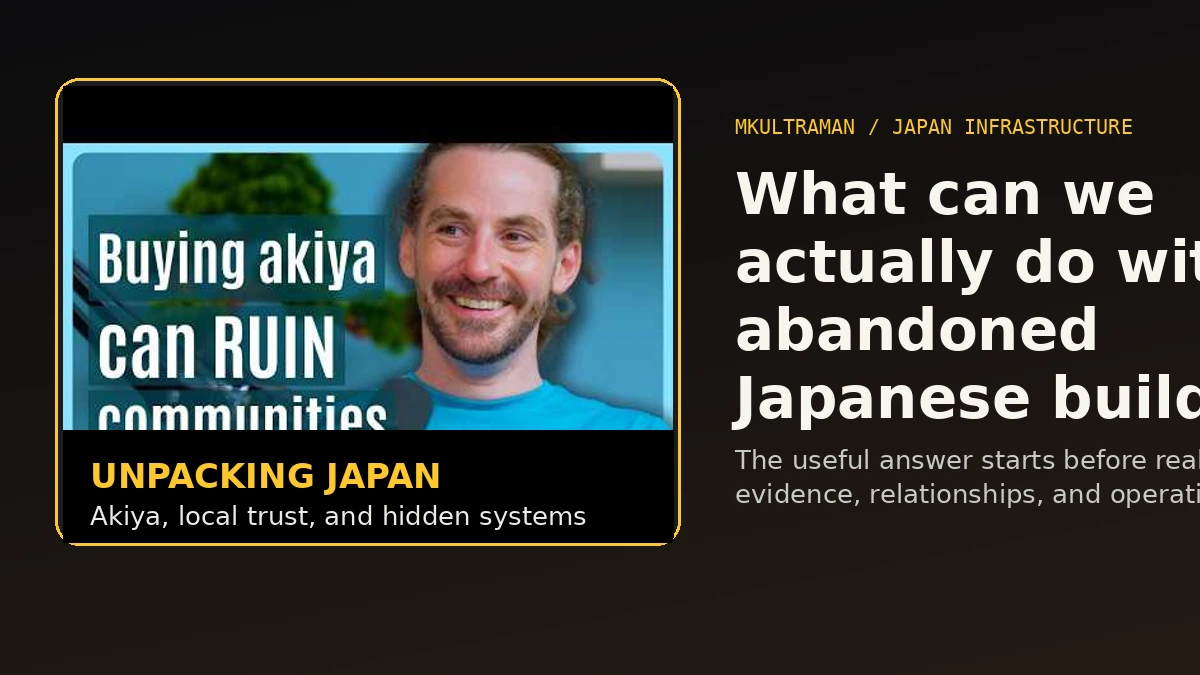
Media appearances are useful when they make the messy middle visible: the records, incentives, relationships, and local constraints behind the simple headline.
Dirty data creates fake scarcity
Before akiya, I ran into a similar pattern in Tokyo’s music scene.
Venues existed. Bands existed. Audiences existed. But the information layer was thin. People defaulted to the same known rooms because the rest of the ecosystem was hard to see. The problem was not that Tokyo lacked spaces. The problem was that the useful map was weak.
Akiya had the same shape.
From the outside, people heard big numbers: millions of vacant homes, shrinking towns, aging owners, depopulation, possible bargains. But the useful questions were much more specific. Which buildings are actually available? Which ones are structurally viable? Which municipalities have usable records? Which towns have builders, architects, administrators, and neighbors willing to work with outsiders? Which projects create value locally instead of just extracting content?
If that data is dirty, missing, or scattered, the market behaves strangely. Good assets stay hidden. Bad assets get romanticized. Serious buyers waste time. Local owners become skeptical. Municipal staff get asked the same vague questions by people who are not ready to act.
This is one of the simplest explanations for a lot of Japan’s “hidden value” problem. The value is real, but it is trapped behind a bad interface.
That interface might be a municipal database. It might be a PDF. It might be a paper ledger. It might be a person at the city office. It might be a network of contractors who do not advertise in English and do not want to be dragged into a half-funded foreign renovation fantasy.
The lesson travels far beyond real estate.
A Japan SME can have the same issue inside its sales process. A food producer can have it in distribution. A professional services firm can have it in client history. A rural industry can have it in supplier data. A founder can have it in the gap between the official website and the actual business.
From the outside, there is no opportunity. From the ground, there is opportunity everywhere, but the map is a mess.
Community trust is infrastructure
One of the parts of the akiya conversation that matters most for business is trust.
Foreign buyers often underestimate how much damage a failed project can do. If someone shows up, raises expectations, takes meetings, asks for special help, makes a lot of noise, and then fails to follow through, the loss is not limited to that one property.
The next buyer inherits the skepticism.
That is not irrational. Rural communities are not demo environments. They are places where people have memories, reputations, obligations, and limited time. If outsiders repeatedly arrive with fantasy budgets and content-first intentions, locals learn to protect themselves.
This is why I am wary of the pure DIY akiya narrative. I understand the appeal. I come from punk scenes. I like scrappy people. But early-stage rural Japan does not need a wave of undercapitalized experiments that create more cleanup work for everyone else. It needs serious operators who respect local constraints, pay professionals, understand the risk, and build something that leaves the community better off.
That may sound harsh. It is mostly practical.
Akiya work is not just property acquisition. It involves legal, tax, renovation, safety, business registration, local administration, neighborhood relationships, and sometimes bilingual mediation between what the buyer thinks is happening and what the Japanese-side stakeholders are actually saying.
That package is part of the product. Ignoring it is how cheap becomes expensive.
Use cases beat fantasies
The best akiya projects usually start with a use case, not a dream image.
A house can remain a house, but it does not have to. It is space. Four walls and a roof, if you are lucky. Depending on the building, location, and local context, that space might become a music studio, a small production facility, a brewery, a workshop, a guest operation, a food processing site, a local retail concept, or something stranger and more useful than the standard countryside-life script.
In the episode, I talked about examples like wild game processing and brewing because they get closer to the point. These are not romantic purchases. They are operating models matched to available space, local inputs, and actual demand.
That is the part people miss when they focus on the purchase price. The building is rarely the strategy. The strategy is the fit between the space and the system around it.
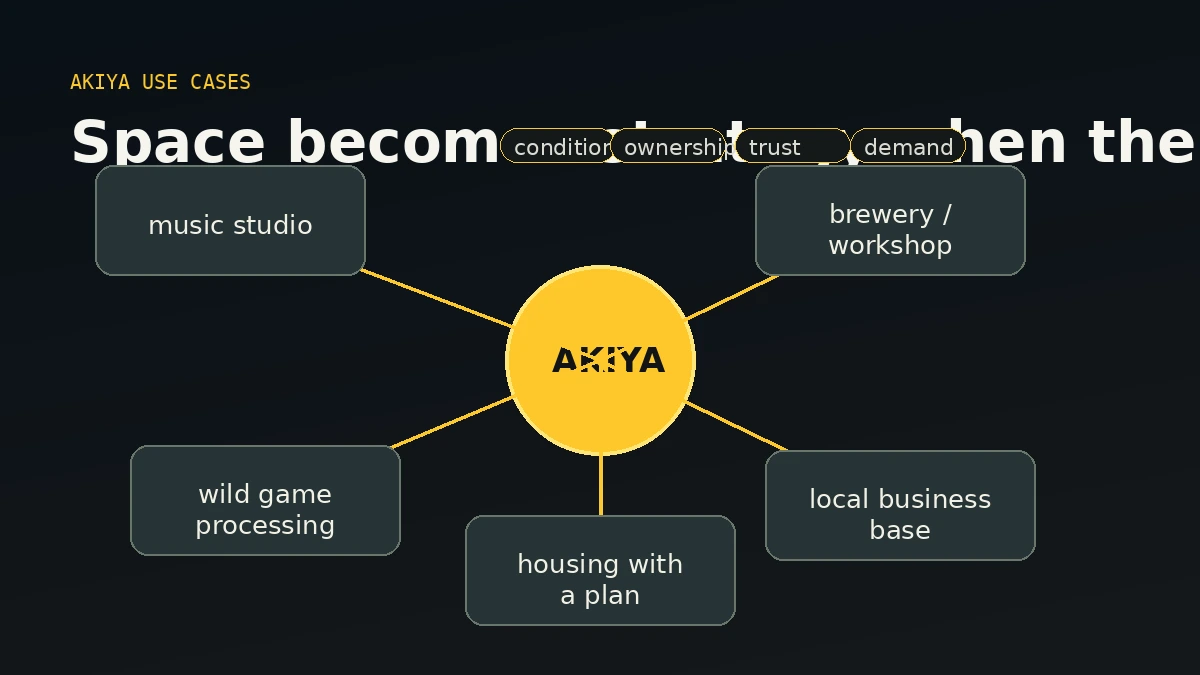
The question is not whether an akiya is cheap. The question is what the building can do, who it serves, and whether the surrounding system can support it.
This is the same problem inside Japan SMEs
Most of my current MKUltraman work is not buying abandoned buildings. It is helping businesses understand and rebuild the systems they already depend on.
But the akiya pattern repeats constantly.
A company thinks it has a website problem. Then we find a positioning problem, an outdated service structure, a CRM nobody trusts, a bilingual handoff that breaks after the first inquiry, a vendor setup nobody owns, and five tools doing pieces of the same job.
A founder thinks they need AI. Then we find that the data is not clean, the workflow is undocumented, the files are scattered, the naming conventions are inconsistent, and the person with the important context keeps everything in their head.
A foreign-owned SME thinks Japan is slow because Japan is slow. Sometimes that is true. Often, the real issue is that the company is operating with a foreign expectation layer sitting on top of Japanese administrative habits, local vendor norms, paper-era assumptions, and half-translated internal processes.
That is not solved by buying another SaaS subscription.
It starts with a map.
This is the logic behind a Technology Health Check. Before recommending tools, automations, migrations, or AI workflows, I want to know what the business is actually doing. Where does information enter? Who touches it? Which system is official? Which system is trusted? What breaks when one person is absent? Which Japanese-side process is necessary, and which one is just inherited friction with better manners?
Akiya taught me to ask those questions in public. Japan SMEs keep proving why they matter.
The buyer I want to attract
If this article does its job, it should probably repel some people.
I am not trying to attract bargain hunters who want Japan to be a cheap backdrop for a personal reinvention story. I am also not trying to attract companies that want a magic AI layer pasted onto a messy operation they refuse to understand.
The people I want to work with are different.
They are foreign founders, managing directors, investors, operators, and owner-led teams who suspect that Japan contains more value than the official interface shows. They are serious enough to pay for due diligence, documentation, local context, and system design before making the loud move. They know speed matters, but they also know that moving fast in Japan without understanding the ground can burn trust that took years to earn.
They do not need a cheerleader. They need someone who can open the cabinets, read the forms, call the offices, compare the records, understand the cultural drag, and turn the mess into something usable.
That is the mission of MKUltraman in business terms: build infrastructure around overlooked value in Japan so serious people can act without pretending the messy parts are someone else’s problem.
Akiya is one proof point. The Miyako disaster infrastructure essay is another. So is the work with foreign-owned SMEs in Japan that need their tools, records, processes, and public positioning to match the reality of how the business actually runs.
Build the map before the move
The lesson from akiya is not “buy property in rural Japan.” It is not “avoid property in rural Japan,” either.
The lesson is simpler and less comfortable: do the infrastructure work before the exciting part.
Before the purchase, map the ownership, renovation path, legal constraints, local relationships, and use case. Before the AI rollout, map the workflow and data. Before the website rebuild, map the offer and the customer path. Before entering a Japanese niche, map the part of the market that is still trapped in paper, habit, local memory, and bad search results.
That is where the advantage is.
Japan has no shortage of neglected assets. Some are buildings. Some are businesses. Some are supply chains, cultural products, datasets, or expertise that never made the jump from local reality into a usable digital system.
The work is to make that value visible without flattening it.
If you are operating in Japan and your business depends on undocumented workflows, local vendor knowledge, bilingual handoffs, messy records, or opportunities the official system does not explain well, start with a Technology Health Check. We will map what exists, identify what is fragile, and build the next layer around the actual business instead of the fantasy version.
That is the part of Japan I keep coming back to: not the obvious opportunity, but the one buried under bad data, old systems, and trust that still has to be earned.