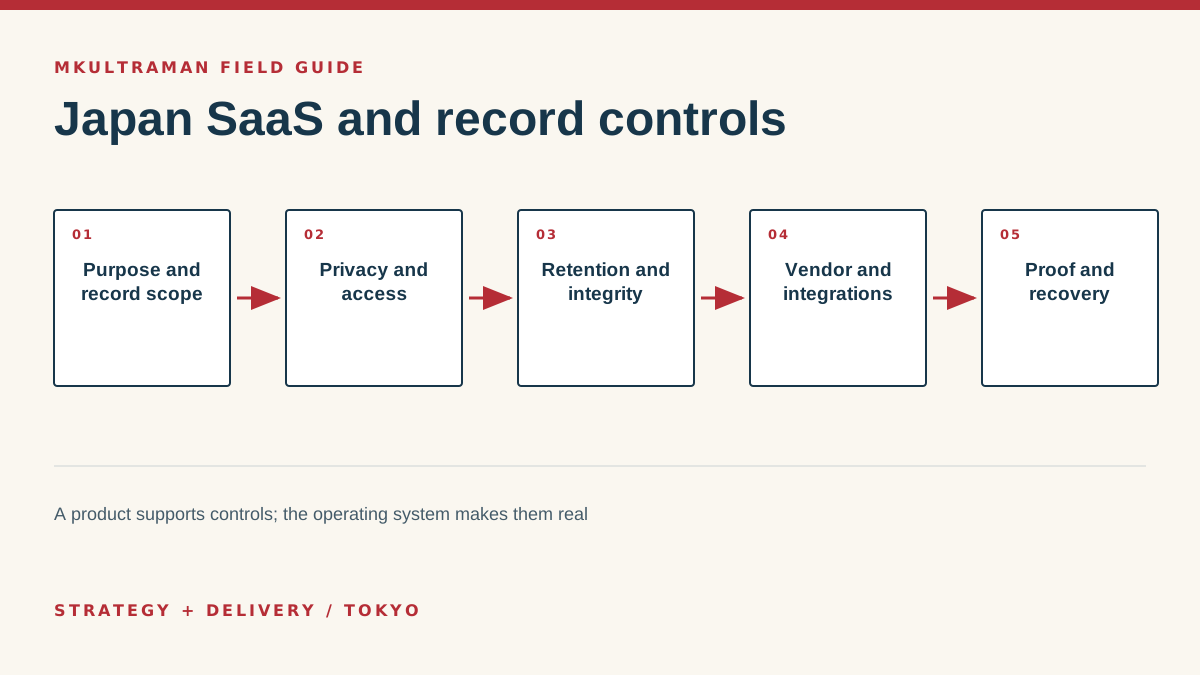
Scope the systems, records and decisions
“Is this SaaS compliant in Japan?” is rarely answerable from a badge or feature list. Compliance depends on what the company does with the service, which records it creates, whose information it holds, where people can access it, how settings are configured and which laws or contracts apply. A vendor can provide capable controls while the customer uses them badly.
Begin with a system and data map. List the SaaS services used for identity, communication, customer relationships, payments, accounting, HR, files, analytics, publishing and automation. Include tools bought by individual teams and free services used for real work. For each, name the business owner, administrator, contracting entity, data categories, users, integrations, renewal and exit path.
Then list consequential record types, not just applications. An invoice may begin in commerce, pass through a payment provider and accounting system, and be stored in an archive. A customer’s consent may begin on a form, update in a publishing platform and appear in CRM. Record obligations attach to the record and activity, not to the marketing category of the software.
Prioritize by consequence
Apply more scrutiny where failure can materially affect people, legal obligations, money or continuity. Payroll, identity, payments, tax records and sensitive customer information deserve deeper review than an isolated public-content drafting tool. This keeps governance usable. Treating every app as equally critical either consumes the entire team or reduces the exercise to unchecked boxes.
Identify shadow SaaS without beginning with punishment. People often choose an unsanctioned tool because the approved path is slow or does not support the job. Understand the need, protect urgent data, and offer a workable route. A policy that forbids useful behavior without an alternative drives the activity out of sight.
Map privacy purpose, access and transfers
For personal information, record what is collected, why, from whom, where, who uses it and how long it is needed. Separate contractual communication, service delivery, marketing and analytics purposes. Minimize collection. If a field has no current job, its hypothetical future value may not justify its risk and administration.
Map data flows through integrations and support. A Tokyo team may use a global SaaS vendor whose infrastructure, subprocessors or support personnel operate elsewhere. Review the Personal Information Protection Commission’s current law and guidance, including relevant cross-border considerations. Vendor privacy pages help describe a service, but the company must evaluate its own use and obtain advice where facts are consequential.
| Question | Evidence | Owner |
|---|---|---|
| Why is the data held? | Purpose and approved process | Business owner |
| Who can access it? | Roles, groups and access review | System administrator |
| Where does it move? | Vendor, subprocessor and integration map | Privacy and technology owners |
| How long is it needed? | Approved retention schedule | Record owner with adviser |
| How can it leave? | Export, deletion and contract terms | Vendor owner |
Control support access and public links. A vendor support agent may need temporary access to diagnose a problem; document the request and close it afterward where controls permit. Review externally shared files and guest users. Use individual identities and multifactor authentication. Shared administrator accounts make it difficult to know who changed a record or configuration.
Design electronic-record controls around trustworthiness
Electronic records need to remain complete, understandable and retrievable for their required life. The exact requirements vary by record and law. Operations must translate the approved rule into creation, approval, storage, search, protection, correction and disposal. A PDF in a folder is not automatically a controlled record, and a vendor’s retention setting is not automatically the right retention period.
Name the authoritative copy. If an invoice exists in commerce, email and accounting, which version is relied upon? Preserve identifiers that connect the copies. Record material corrections rather than silently replacing history when an audit trail is required. Use timestamps and approved workflows appropriate to the consequence. Avoid exporting data into an uncontrolled spreadsheet that becomes the actual operating record.
Plan retention and deletion together
Retention has two failure modes: deleting too early and keeping everything forever. Obtain the applicable schedule, then map product behavior. Can records be locked, archived or deleted by ordinary users? What happens when a user account is removed? Does backup extend availability after deletion? Do exports retain metadata and relationships? Test these questions with representative records.
For electronic transaction and bookkeeping records, review current National Tax Agency information and obtain accounting or tax advice. Requirements and transitional details can change. Preserve the configuration evidence, procedure and responsible person, not just a screenshot of a vendor claim.
Review vendors and contracts in proportion to risk
Review the contracting party, service description, availability commitments, support, security materials, privacy terms, subprocessors, data locations, incident notice, deletion, export, intellectual property, price changes, termination and liability with qualified advisers as needed. Do not assume enterprise terms apply to a self-service account. Save the accepted version and renewal date.
Ask operational questions. Can the company create two administrators? Are role permissions granular enough? Are logs available in the purchased tier and retained long enough? Can a departing administrator be removed without vendor intervention? Can the company export attachments, activities and relationships? How does the vendor announce material changes?
Certifications can be useful evidence about defined controls and scope, but they are not universal approval. Read what entity, product and period they cover. A report may be available only under confidentiality. Decide what evidence the company needs given the use, and record the review rather than collecting documents nobody interprets.
Control integrations and AI features
Every integration grants a path between systems. Record its owner, permissions, data direction, transformation, failure alert and removal process. Review OAuth applications and API keys. Prefer short-lived or narrowly scoped credentials where supported. Remove unused connections before renewing tools.
AI features can change how data is processed, retained or used. Before enabling them broadly, identify the task, information involved, output consequence, provider terms and human review. Pilot with low-risk material. Keep a non-AI path for critical work when the feature is unavailable or unsuitable. Do not treat a new toggle as permission to send all company records to another service.
Prove controls and keep them current
Test access, export, retention, recovery and deletion with representative records. Run an administrator-recovery exercise. Export a critical dataset and open it outside the service. Remove a test user and confirm ownership and access behave as expected. Trigger an integration failure and confirm someone receives a useful alert. Evidence from these tests is stronger than a policy that has never met the system.
Set review triggers: staff departures, new data categories, material integrations, AI activation, contract renewal, security incidents, business acquisitions and regulatory change. Also set a periodic risk-based review. Critical access may be checked quarterly, while lower-risk tools receive an annual inventory review.
Keep a concise control register linking the requirement, implementation, owner, evidence and next review. Archive old configurations when they matter. Record exceptions with an approver and expiry date. If a workaround becomes permanent, either formalize and secure it or replace it.
A well-governed SaaS environment remains changeable. The company can state what information it holds, explain the purpose, control access, produce required records, investigate changes, recover service and leave a vendor with usable exports. That operating capacity is more valuable than a static list of products described as compliant.
Tips and practical checks
Small moves that prevent expensive cleanup
- Begin with one important record type and trace its full life from creation to deletion or archive.
- Separate legal retention advice from product retention settings. A configurable feature does not decide the company’s obligation.
- Use individual identities, narrow administrator roles and periodic access review for systems holding sensitive or consequential records.
- Capture configuration evidence after changes so the organization can show what was active, when and under whose authority.
- Test bulk export and readable restoration before a contract renewal makes exit more expensive.
- Keep a register of subprocessors, hosting regions, support access and material contract changes for critical SaaS.
FAQ
Frequently asked questions
Does buying a compliant SaaS product make the company compliant?
No. Vendor features and certifications can support the company’s controls, but the customer still decides purpose, configuration, access, retention, staff behavior and response procedures. Suitability depends on the actual use.
Does every electronic record need the same retention period?
No. Requirements depend on record type, business purpose, contractual needs and applicable law. Get professional advice for the company’s obligations, then configure systems and operating procedures to implement the approved schedule.
What is a useful SaaS vendor review for an SME?
Review the contracting party, data handled, access model, hosting and transfers, subprocessors, security evidence, incident terms, deletion, export, support, price changes and business continuity. Apply more depth to more consequential systems.
How often should controls be reviewed?
Review after material process, product or regulatory changes and on a risk-based schedule. Critical administrator access and recovery deserve more frequent checks than a low-impact publishing tool.
Sources and further reading
Official references
Product features, prices, and Japanese requirements can change. Check the primary source before making a consequential decision.
- Act on the Protection of Personal Information and guidance ↗ Personal Information Protection Commission, Japan
- Electronic Books Maintenance Act information ↗ National Tax Agency, Japan
- Japanese Law Translation database ↗ Ministry of Justice, Japan
- Cybersecurity Management Guidelines ↗ Ministry of Economy, Trade and Industry, Japan
- Cloud service security resources ↗ Information-technology Promotion Agency, Japan