Akiya, property and regional Japan
Japanese Jesus and the Shingo Legend
Japanese Jesus turns the Shingo legend, the story that Christ died in rural Aomori, into a folklore and mythwear project meant to bring attention and money back to the village.
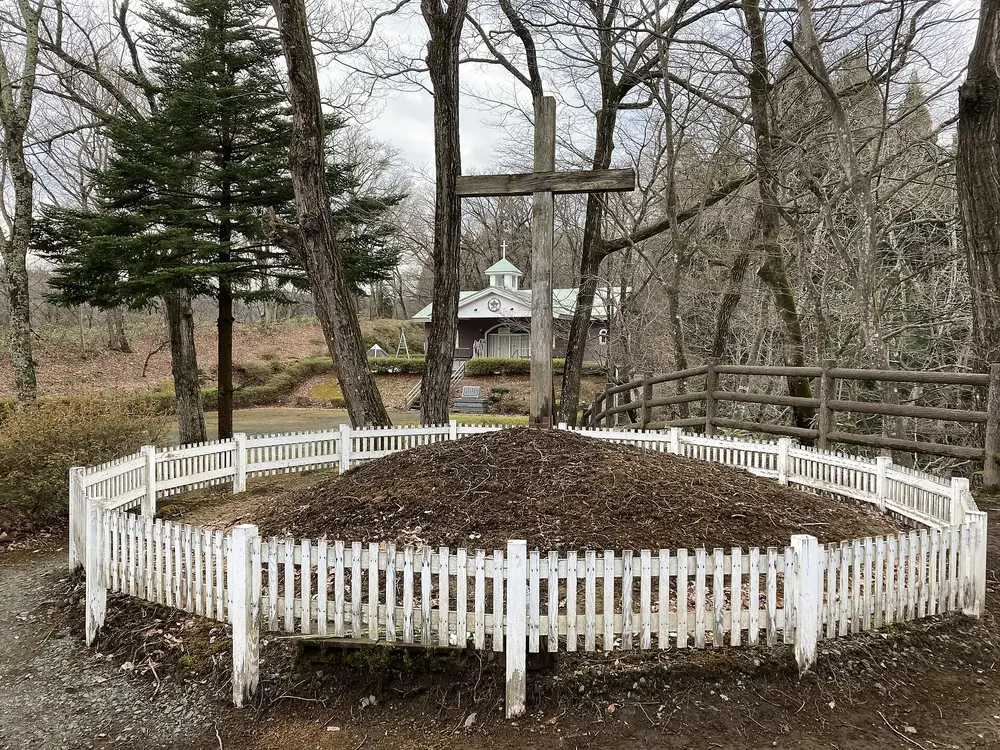

The mist in Aomori softens everything, including how strange the Shingo legend sounds when you first hear it. Standing in the village, it is easy to see why the story has survived. It belongs to a quiet, remote place where very little of Tokyo’s noise reaches. That is what drew me to build Japanese Jesus, a project that takes the raw, odd folklore of this corner of Tohoku and turns it into something people can wear.
Japanese Jesus, as in Jesus Christ with a very different ending, is not a religious project. It is a folklore and design project with a practical aim: to make a neglected village interesting enough that people want to learn about it, buy from it and eventually visit. The story at its center is of a savior who escaped the cross and lived out his life as a rice farmer in northern Japan. My bet is that a story that strange, told well, can do more for a fading village than another brochure.
Why not just follow the tourists?
Anyone who has been to Kyoto recently has seen the other side of Japanese tourism. The famous temples and streets are packed, the “Golden Route” of Tokyo, Kyoto and Osaka carries most of the traffic, and much of what visitors see has been shaped to be photographed and sold. I have written separately about tourist behavior and pressure in Kyoto. The result can feel like a theme park that ends in a gift shop.
I am far more attached to Tohoku. The north is wild and not especially welcoming to casual visitors. Winters are serious, and bear encounters in the region have been in the national news for good reasons. The Shingo legend has lasted partly because it sits so far from the usual routes.
Rural Japan needs new sources of interest, and I do not think more hotels or more subsidies alone will provide them. What these places often lack is a story that travels. Japanese Jesus is my attempt to give one village that kind of story, told with enough energy to cut through.
This is bootstrapped. The goal is to raise money through products to build a brand tied to Shingo, rather than waiting for a grant or for someone’s permission.
What is the Shingo legend?
The legend comes from documents that surfaced in the 1930s, later presented as ancient records. According to the story, Jesus came to Japan as a young man, studied here, and returned to Judea to preach. The crucifixion did not end his life: his brother Isukiri died on the cross in his place. Jesus then traveled east across Siberia and settled in Herai, the old name of the village now called Shingo. He became a rice farmer, married, raised a family and died at the age of 106.
The village has two grave mounds marked with wooden crosses, one said to be his and the other holding relics of his brother. Visitors can find them in a small grove, and the Grave of Christ in Shingo has become a minor pilgrimage for people who love the unexpected. Every year the village also holds a festival at the site, blending Shinto ritual with a story imported from the other side of the world.
Nobody needs to believe any of this to find it fascinating. What interests me is what the story says. In the Shingo version, the divine ends up not in heaven but in the mud of Aomori, living an ordinary life and watching the seasons. It moves the center of one of the world’s biggest stories to a tiny village in northern Japan. There is something wonderfully defiant about that.
Building a myth engine
Religion is far too heavy a frame for this. I think of the project instead as a myth engine: it takes an existing local legend and turns it into clothing and objects with a strong, specific look. Wearing a piece does not ask anyone to believe anything. It just asks them to notice, and it tends to start conversations. Each shirt becomes a small way for the story to travel.
I did not invent this legend. It already lives in Herai. My job is to support what is there and give it a form that people outside the village can pick up.
What does the design look like?
The visual language is something I call neon occultism: rural shrines under ultraviolet light, a little static and grain, cosmic Japan seen through a cracked screen. I deliberately avoid the soft pastels most people associate with Japanese design.
The motifs lean into that. Three-eyed suns sit above a frost line. Torii gates dissolve into circuitry. Halos are built from broken neon tubes. Edo-period woodblock textures meet digital glitches, like a history book from a timeline that went slightly wrong. If you have read my piece on psychedelic art in a professional identity, you will recognize the taste behind it.
A story about Christ dying in Japan at 106 needs more than beige linen to be noticed. I treat each product as an artifact from the “Herai Years” rather than a stock item. The clash in the style is intentional. It mirrors the unlikely meeting of cultures at the heart of the legend.
Is it disrespectful?
I take that question seriously. The project is clearly separate from Christian doctrine. There is no church, no preaching and no claim that the legend is historical fact. It lives in the space between truth and fiction, the “what if” that makes Shingo interesting in the first place.
Respect for the village matters just as much. Any future move into tourism has to be gradual and controlled. The grove at Shingo is small, and the point is to bring curious, considerate visitors, not coachloads looking for a restroom and a photograph.
Where does the money go?
I am open about the commercial side. Japanese Jesus is a business. The products are meant to generate revenue that goes back into building the brand and developing cultural projects linked to Shingo. There are no investors expecting a quick return, so the vision does not have to be diluted to satisfy anyone.
I would like it to show a working model for rural revitalization that does not depend on government support: a place that thrives because it has something genuinely distinctive and has found a way to share it. If that works for a village as remote as Shingo, the approach could work in many other places. I have written about similar thinking in the Aizu strategy for rural cultural assets.
What comes next?
Once the products are established, I want to explore digital projects that carry the Shingo legend further online. The root will always stay physical, tied to the soil in Herai. On one side there is a silent village in the mountains; on the other, the noise of the internet. The project sits between them and tries to carry the signal across.
I call it mythplay. Putting on the jacket is an invitation to play along with an alternate timeline for a while, and maybe to go and see the village that inspired it.
Further reading: Japanese Jesus · Aizu strategy for rural cultural assets · Japan entrepreneurship and rural revitalization